Genocide லேபிளுடன் இடுகைகளைக் காண்பிக்கிறது. அனைத்து இடுகைகளையும் காண்பி
Genocide லேபிளுடன் இடுகைகளைக் காண்பிக்கிறது. அனைத்து இடுகைகளையும் காண்பி
சனி, 11 ஜனவரி, 2014


வியாழன், 26 டிசம்பர், 2013
Genocide has to be compensated by separation: Sikh politician
Genocide has to be compensated by separation: Sikh politician
[TamilNet, Wednesday, 25 December 2013, 22:30 GMT]
“Tamils can’t live [in a united Sri Lanka] after the perpetration of the crime of genocide. I think the wounds are too deep historically there to be reconciliation. After a State has committed genocide, there can’t be any reconciliation,” says Simranjit Singh Mann, the president of Shiromani Akali Dal Amritsar party, who advocates the formation of Khalistan as an independent and sovereign State for Sikhs, in an exchange of views with May 17 Movement in Tamil Nadu. “Pirapaharan and his movement was too powerful for the Sri Lankan government,” he said, adding that “it was under the collaboration of UPA-led Congress government that the Sri Lanka government was able to achieve and crush the movement for freedom by committing a genocide on the Tamil people in Sri Lanka.”
“Tamils can’t live [in a united Sri Lanka] after the perpetration of the crime of genocide. I think the wounds are too deep historically there to be reconciliation. After a State has committed genocide, there can’t be any reconciliation,” says Simranjit Singh Mann, the president of Shiromani Akali Dal Amritsar party, who advocates the formation of Khalistan as an independent and sovereign State for Sikhs, in an exchange of views with May 17 Movement in Tamil Nadu. “Pirapaharan and his movement was too powerful for the Sri Lankan government,” he said, adding that “it was under the collaboration of UPA-led Congress government that the Sri Lanka government was able to achieve and crush the movement for freedom by committing a genocide on the Tamil people in Sri Lanka.”

Simranjit Singh Mann
A major tactic deployed by the
Indian State was to make sure that Tamil Nadu didn’t rise up to exert
pressure on the Indian Government. This was achieved through wooing
collaborators from Tamil Nadu with positions and money, he said.
“The Tamil people would have listened in revolt and in favour of what was happening to the Tamils in Sri Lanka [in 2009]. But, for the fact that these Tamil leaders had been ‘bought over’, this didn’t happen,” the Sikh leader told Tamil activists from Tamil Nadu.
“Government of India rules Tamils of Tamil Nadu and the Sikhs of Punjab through collaborators, in keeping the Tamils and the Sikhs subdued and not letting in the nationalist feelings be turned into votes,” Mr Simranjit Singh said drawing parallels between the genocide against Sikh people and the genocide against Eezham Tamils.
“I came across Mr Vaiko while I was in parliament from 1999 to 2004. But, other than that, the Tamils have not taken up the cause of the Tamil people in [Indian] parliament,” Mr Simrajit Singh said.
“My experience of the Tamil people is that when the Central Government of Mr Sastri [in 1964-66] wanted to impose Hindi all over India and abolish English [as lingua franca], it was the Tamil people who rose up against it. They committed mass suicides. The pressure went up that the Hindi-speaking Northern Indian people had to give up their designs to poise Hindi on all of India,” he said.
The Sikh politician was advocating for the use of electoral politics as a means to demonstrate the democratic will of the people [of Tamil Nadu].
“The Tamil Nadu State and the Tamil people in India will have to help Tamils in Sri Lanka to achieve their independence,” he said.
“Democracy gives legitimacy. If we had elected representatives from Punjab and the other territories, we can pass a resolution and that would be accepted by the world,” he said.
“But, if you try any other methods of gaining independence, the world opinion will go against you. You would be crushed not only by the State from which you want to separate, but the forces, which are operated in the world,” he said.
“Once, the American foreign policy was so great and Woodrow Wilson wanted the right of self-determination and he created Nations after First World War on the principle of nationalities. But today, America doesn’t believe in human rights, it doesn’t believe in the right of self-determination, in the right of people being the masters of their own destiny as sovereign states.
“At the moment, or even during the British period, the Hindus got their independence through Congress and the Muslims got Pakistan through the Muslim League. They did fight the elections and that was the only determining factor on expressing what you want. If the history of our sub-continent to be followed, it was the determination of the people through the elections that made their voice legitimate and acceptable to the rest of the world,” he said.
On a question on whether a policy change was possible in the Indian establishment on the question of Tamil Eelam, he said: “The theocratic State of India is very scared of helping independence movements, because it is so fragile with the Nagas, with the Kashmiris, with the Mizos, with the Tamils and with the Sikhs. If you see the periphery of India, the theocratic State over here rules all these states with the help of the Army and draconian laws, which give impunity to the Army and the police forces to commit crimes on the people. So, I don’t think that the Indian ruling class, the theocrats, they will ever help the Eezham people to separate.”
“I don’t think the attitude of the UN is helpful to freedom movements though on its charter it allows for right to self-determination and the obliteration of the death penalty and things like that. But in practice, it is going along with the rulers who commit these crimes, whether they be anywhere. The UN at this moment of time is going along with the repressive governments.
“Since the elections are near, your organizations should put up candidates who are Tamil nationalists, who want separation, sovereignty and independence. Then only can the crime of genocide perpetrated in Sri Lanka would be recognized. Like the Armenian people and the Armenian genocide, it took years and years for it to be registered in the American Congress and the Senate etc.
“So, if we want Sikh genocide to be registered in international forums, we need to have independent people in parliaments and in the legislatures to speak on this.
“Tamil and Sikh people who are represented at these so-called democratic bodies [in India] do not take up these issues.
“We want Khalistan to be an independent and sovereign Sikh State, which would be a buffer between Islamic Pakistan, Communist China and theocratic Hindu Indian State. Khalistan would ensure peace internally in South Asia, because the theocratic Hindu India, communist China and Islamic Pakistan, are deadly enemies [against each other] and a nuclear war can break out.
“What would be the battlefield for the nuclear war? It is the Sikh territories of Rajastan, Punjab, Hariyana, Chandigarh, Jammu Kashmir and Himachal.
“If a buffer State is created, the Sikhs would also be safe and the Hindus and Muslims who live here would be safe. Apart from that it would create peace in South Asia. For a plebiscite for the right of self-determination, we are in favour of an independent and sovereign state.
Further excerpts from the exchange of views follow:
“The brutality and the perpetration of genocide of the Tamil people has been so severe by the Sri Lankan government that there cannot be any reconciliation after this crime has been committed – just like it was impossible for the Jews to live inside Germany after what they went through in the era of the holocaust during the second world war and Armenia which couldn’t stay with Turkey or any other country – they have to be separated after this. The Sri Lankans have committed enormous crimes on Tamil people living there. The Tamil Nadu State and the Tamil people in India will have to help them to achieve this.
[…]
“The 13th Amendment doesn’t go as far as total independence and sovereignty. It talks about internal settlement […] I don’t agree with that. The Tamil people of Sri Lanka have to be independent. They must be the masters of their destiny after what they have gone through.”
[…]
If there are elections [under 13 Amendment], the people who are elected and who would be put as administrators or chief ministers or whatever you call that, they would become the collaborators of Sri Lanka.
[…]
“We have always been keen about the struggle of Tamil people under Pirapharan and the mobilization for freedom and separation. Our party has followed these events very closely. If you see our website, we have tabulated each and everything from time to time what has been happening in Sri Lanka and to the Tamils.
“It was under the collaboration of India under UPA-led Congress government that the Sri Lanka government was able to achieve and crush the movement for freedom by committing a genocide on the Tamil people in Sri Lanka.
“And the reason was that the Congress Party believed, rightly or wrongly, it was the Tamil people, who had assassinated their leader Rajiv Gandhi. And, they had been working in many ways to have Pirapaharan and some other people extradited from Sri Lanka. Those in the Sri Lankan government wanted to ‘help’ India. But, the fact was that Pirapaharan and his movement was too powerful for the Sri Lankan government and its Army to capture him alive and hand him over to the Indians.
“So, in a plot and conspiracy with the Sri Lankan government, they first bought over the Tamil [Nadu] political leaders like Mr Karunanithy and Mr Chidamparam. Then, by bribing these Tamil leaders, they kept the people of Tamil Nadu from not helping the State movement for the Tamil people in Sri Lanka.
“For instance, Mr Karunanidhi and the Central Government had his daughter in an important post. Mr Raja was given a ministerial post in which they made a lot of money. Mr Chidambaram had also made a lot of money. That is how they suppressed [Tamil Nadu].
“My position is that the Tamil people would have listened in revolt in favour of what was happening to the Tamils in Sri Lanka. But, for the fact that these Tamil leaders had been ‘bought over’, this didn’t happen.”
“The Tamils constitute a separate Nation. They are a separate race. They have their separate Hindu religion. But, they are oppressed by the Brahmins, who have been priests for generations – by the Brahmanical system in India. Tamils have a separate language, separate history, they have a separate school of drama, music, art, and in the history, they have ruled their land and they have been great colonizers in South East Asia.
“And I do believe that the Tamil people should, like the Sikhs, be separated and should have their own sovereign State, like what we Sikhs are fighting for.
“So, we studied the Tamil movement very closely and have been to Tamil Nadu and have given speeches. We have spoken very freely that the Government of India rules Tamil Nadu and the Punjab and the Sikhs through collaborators, who collaborate with the Government of India in keeping the Tamils and the Sikhs subdued and not letting the nationalist feelings be turned into votes.
“Since the elections are near, your organizations, should put up candidates who are Tamil nationalists, who want separation, sovereignty and independence. Then only can the crime of genocide perpetrated in Sri Lanka would be recognized. Like the Armenian people and the Armenian genocide, it took years and years for it to be registered in the American Congress and the Senate etc.,
“So, if we want Sikh genocide to be registered in international forums, we need to have independent people in parliaments and in the legislatures to speak on this.
“Tamil and Sikh people who are represented at these so-called democratic bodies do not take up these issues.
வெள்ளி, 13 டிசம்பர், 2013
UN failed in Sri Lanka, says Dieng
UN failed in Sri Lanka, says Dieng
[TamilNet, Thursday, 12 December 2013, 04:11 GMT]
United Nation's Special Advisor on Prevention of Genocide to the Secretary General (SG), Adama Dieng, said during a UN panel discussion Wednesday that not only the United Nations but all member states failed the people of Sri Lanka. He implied that while the SG did not make use of Article 99 which bestows power on the SG to refer to the Security Council situations that threatened international security, the SG set up panels to identify witnesses and has now set up the "Rights Up Front plan," which might have prevented the situation [killings] in Sri Lanka. Meanwhile, Amady Ba, the Deputy Prosecutor to the International Criminal Court, referring to the killings, said that the ICC has no jurisdiction over countries that are not party to the Rome Statute.
United Nation's Special Advisor on Prevention of Genocide to the Secretary General (SG), Adama Dieng, said during a UN panel discussion Wednesday that not only the United Nations but all member states failed the people of Sri Lanka. He implied that while the SG did not make use of Article 99 which bestows power on the SG to refer to the Security Council situations that threatened international security, the SG set up panels to identify witnesses and has now set up the "Rights Up Front plan," which might have prevented the situation [killings] in Sri Lanka. Meanwhile, Amady Ba, the Deputy Prosecutor to the International Criminal Court, referring to the killings, said that the ICC has no jurisdiction over countries that are not party to the Rome Statute.
| Adama Dieng responds |
The Genocide panel discussion was moderated by Mr. Tunku
Varadarajan, a Research Fellow at Stanford University's Hoover
Institution.
Mr. Amady Ba represented Mrs. Fatou Bensouda, the Prosecutor of the ICC
who couldn't attend the event.
In the videos, Amady Ba and Adma Dieng were responding to the following question from the audience:
In the videos, Amady Ba and Adma Dieng were responding to the following question from the audience:
| Amady Ba of ICC responds |
"Could each speaker explain their perspective on handling difficult
situations such as a precursor to what happened in Syria namely Sri
Lanka, where allegations of war crimes, crimes against humanity and
genocide have been raised continuously since the end of armed conflict
in 2009, but Sri Lanka is not a party to the Rome Statute and the UN
Security Council has been polarized politically (just like Mr. Haid
said) whenever the situation of Sri Lanka is raised? Meanwhile, UN High
Commissioner for Human Rights Navi Pillay has reported that continuing
impunity for Sri Lanka's atrocities in 2009 has enabled further
deterioration in the situation -economic, social, cultural, personal
security- of the Tamil and Muslim communities. What options for recourse
and justice do Tamil victims have in situations like Sri Lanka, and how
can issues of international justice and accountability be
de-politicized (as many of you have questioned) to truly end impunity?
Specifically with regards to Mr. Ba (reprentative member of ICC) -- can
the prosecutor's propio motu powers be used against Sri Lanka?" and
could the Secretary-General use Article 99 to take action to protect the
Tamil community on the island?

UN Genocide panel answering questions

Amady Ba, Deputy Prosecutor ICC

Adama Dieng, Adviser to SG on Prevention of Genocide
Amady Ba refers to the "Proprio
motu" power which is used to refer to a decision by the Prosecutor of
the International Criminal Court to initiate an investigation into a
situation without a referral from the Security Council or a State Party;
this power is granted by article 15(1) of the Rome Statute.
Ba says the Prosecutor is helpless since Sri Lanka is not a party to the Rome Statute. In an earlier CNN interview, the former ICC Prosecutor, O'Campo also said the same.
On 17 July 2012, Secretary-General Ban Ki-moon announced the appointment of Adama Dieng of Senegal as Special Adviser on the Prevention of Genocide. Mr. Dieng has served as Registrar of the International Criminal Tribunal for Rwanda since 2001. He began his career as Registrar of the Regional and Labour Courts in Senegal, and served as Registrar of the Supreme Court of Senegal for six years. From 1982 to 2001, Mr. Dieng worked for the International Commission of Jurists, for the last ten years as the organisation’s Secretary-General. During this period he was appointed as Envoy of the United Nations Secretary General to Malawi in 1993, and as the United Nations Independent Expert for Haiti from 1995 to 2000.
Related Articles:
16.02.10 UN rights chief says lack of progress in Sri Lanka investiga..
External Links:
| UN: | Special Adviser on Prevention of Genocide, Adama Dieng |
திங்கள், 18 நவம்பர், 2013
சனி, 12 அக்டோபர், 2013
Kidding a genocide affected nation
Kidding a genocide affected nation
[TamilNet, Friday, 11 October 2013, 20:58 GMT]NPC Chief Minister CV Wigneswaran, who claims that he has been installed in the position by the grace of India, and the TNA Parliamentary Group Leader R. Sampanthan, were ‘crowned’ at the end of the oath-taking ceremony for the NPC members, held in Jaffna on Friday. Wigneswaran, in addition, was handed over with a spear of God Murukan. In the beginning of the ceremony, the NPC members declined to wear even traditional garlands. Tamil public in Jaffna viewed the new ‘culture’ surfacing with Wigneswaran polity as obnoxious when the solution-path he is showing is hollow, non-descript and simulated by the very forces that were in complicity with the genocide, media circles in Jaffna said.
Wigneswaran was commenting on the ‘ego’ of the LTTE just in January this year.


The crowning episode on Friday took place only a few minutes after the following address by Sritharan MP from Ki'linochchi:
Chronology:
11.10.13 Kidding a genocide affected nation
வெள்ளி, 4 அக்டோபர், 2013
TNA should learn from history: Poonkuzhali Nedumaran
TNA should learn from history: Poonkuzhali Nedumaran
[TamilNet, Thursday, 03 October 2013, 23:38 GMT]
The Tamil National Alliance (TNA) should learn from history, and from the experience of their predecessors, on what should NOT be done, writes Tamil Nadu political activist Poonkuzhali Nedumaran in a feature sent to TamilNet this week. She cited the history of TNA’s predecessor TULF failing in upholding the responsibility it was vested with by the people in 1977, compromising with District Councils and how that triggered the Tamil youth to lose confidence in parliamentary methods. The NPC election results mean communication of a will than participation in governance. With the Eezham Tamils rejecting the polity and rule of the State in Colombo, the TNA must understand the responsibility vested with them by the people, she further said.
The Eelam Tamils know very well, that after the elections, the Sinhala rulers, having lost the elections, will avenge them outrageously with their military. Even then, they have risked their life and have sent out their message, Poonkuzhali said, adding that the message is nothing but rejection of the polity and rule of the Sinhala State in Colombo.
The election also shows that the Eelam Tamils are slowly coming out of the trauma and have started to fight back. That is why - beyond dense military presence, attacks on Tamil candidates, intimidation and humiliation in polling booths, Eelam Tamils have risked their lives to restore their dignity, she observed.
She traced a pattern in Tamil voting since 1977: TULF contesting on the Vaddukkoaddai Resolution based manifesto captured 18 out of 19 seats in 1977; 95 per cent boycotted local body elections in 1983 when the LTTE called for a boycott; TNA won 22 out of 23 seats in 2004; in 2005 when the LTTE wanted people to boycott the presidential elections, 95 per cent boycotted, and now the TNA victory.
The pattern is that whenever Eezham Tamils get a chance to vote they listen only to their own parties and not to any Sinhalese party. They categorically reject the rule of Sinhala polity and the rule of southern Sri Lanka over them, Poonkuzhali observed.
The election results also show what dangers are awaiting Eezham Tamils in the North, through demographic changes in the model that had already endangered the East, she cautioned.
“There are chances that this election results would have sent alarming messages to the ruling Sinhalese, which will motivate them to increase the unauthorised rampant settlement of Sinhalese in the North. Already the coastal areas of Vanni, Mannar and Mullaitheevu and the fertile lands of Vavuniya are occupied by the Sinhalese settlers. If this increases, the Eelam Tamils will be losing their legal hold on their homeland,” she cautioned further.
What Poonkuzhali fears should be achieved by the State in Colombo as quickly as possible, as the ‘lasting solution’ for the national question in the island, is the envisagement of New Delhi and Washington that have designed and decided the course of the genocidal war, and have set an internationally binding post-war process based on the Sinhala State’s LLRC recommendations.
Therefore, unless the Eezham Tamils, global Tamils and especially the Tamils in Tamil Nadu exercise their geopolitical weight and address the struggle directly and specifically against those two Establishments to the extent of affecting their geopolitical interests, no solution is going to come especially to the danger last mentioned by Poonkuzhali, commented Tamil activists for alternative politics in the island.
How the politicians were chosen for the NPC elections and what they have uttered before and after the voting are also messages sent to Tamils everywhere that the struggle is no more local or regional and that it has entered into a hitherto unseen internationalised phase, and that Tamils have to be prepared for that, the activists further commented.
* * *
Full text of the feature by Poonkuzhali Nedumaran:
As nation-states move past war or even genocide, politics should eventually return to normal. But Eelam Tamils, still recovering from the killing field at Mullivaikaal in 2009, are put in a position to take up an abnormal political course, while the intention of genocide against them is very much alive and the structural genocide in a hitherto unseen and accelerated way is a daily routine. It is in such a context, the recent NPC election stands out, being different from all the ones that preceded it in the island in the post-colonial times.
Electoral politics in Sri Lanka can not be reasonably disentangled from political definition of provinces in Sri Lanka’s constitutional scheme. The provinces are the first level administrative divisions, and were first established under British colonial rule in 1833, after abolishing the territorial identities of the three kingdoms I the island. Initially there were five provinces which became nine later. However, over the next century most of the administrative functions were transferred to the districts, the second level administrative division, and by the mid-20th century, the provinces had become merely ceremonial, vacant of meaningfully delegated political power.
The state’s allocation of, or lack thereof, of Tamil political power within the constitutional scheme of government has been a contentious issue since the dawn of the post-colonial era on the island. Tamil political parties have consistently requested for a greater voice in the political system, be it through federalism or the exercise of the right to self-determination. For example, right from 1948, the first political demand of the Eelam Tamils was a Federal System of Government, in which the Eelam Tamils have a single Province of their own with rights to rule themselves. This demand had been insisted time and again by several Tamil political leaders.
The 1987 Indo-Sri Lanka Accord signed between Rajiv Gandhi and J. R. Jayawardane, proposed an amendment to the 1978 Constitution of Sri Lanka, calling for Provincial Councils as an elected administrative body. This amendment is popularly known as the 13th amendment. History suggests, the 13th amendment was subterfuge for denying, rather than granting Eelam Tamils greater political autonomy. Though it was said that the purpose of 13th amendment was decentralization of powers, in practice it was not so.
While the Eelam Tamil demand was for the integration of the North and East of Sri Lanka as a single Province drawn from the Tamil homeland, the 13th amendment essentially did the opposite. It failed in categorically asserting to the unity of the North and East and it provided space for Sri Lanka’s judiciary to delink even the provisional unity of the contiguous space of Eezham Tamils. Furthermore, the demand for a Tamil Province was primarily for the Eelam Tamils to have control over their homeland. However, to obstruct and dilute this aspect, the 13th amendment devolved power to all the 9 Provinces, of which demographically, seven were Sinhala, and two were Tamil Provinces. While there is not much need for the Sinhala Provinces to have additional powers, as the Government of Sri Lanka is by itself a Sinhalese State, the need of the Eelam Tamils was overlooked, obfuscated within the political concept of unitary Sri Lankan identity. The Provincial Councils thus formed are powerless. Even the basic local administrative organs of Land and Police were vested with the Government of Sri Lanka. This was nowhere near the Federal System of Government. The Provincial Councils are neither federal in form nor in substance.
Now with Sri Lanka hosting the Commonwealth Conference in November 2013, and with the mounting International pressure, the Government of Sri Lanka is forced to show the world that the Eelam Tamils are at peace and the Government has restored democracy back in the island.
It is in this context that the Provincial Council Elections were conducted in the Northern Province of Sri Lanka comprising of Jaffna and Vanni regions, which form the main part of Eelam Tamils' traditional home land. The first election to the Northern Province under a provisionally combined North and East, was conducted in 1987 with the presence of the IPKF. After that, this is the second time that the Northern Province of the island is voting to elect a Provincial Council. To camouflage the disparity existing in the political arena, elections were conducted for the Central Province and the North Western Province also along with the Northern Province.
In the Northern Province, Tamil National Alliance, comprising now of 5 Tamil Political parties, viz., TELO, EPRLF, PLOTE, TULF and ITAK, has won 28 out of the 36 seats, thereby qualifying to get 2 bonus seats. The ruling alliance, UPFA of Mahinda Rajapakse has got 7 seats and Sri Lanka Muslim Congress has won 1 seat.
Setting aside the debate on what powers that the Provincial council has, or whether TNA is going to bring about a change, there is much more to understand from the statistics the results provide.
Statistics indicate that TNA has secured 84.37% of the total votes polled in Jaffna and 65.89% of the total votes polled in Vanni region. Rajapakse's UPFA has secured 14.2% in Jaffna and 22.1% in Vanni. Ranil's UNP has secured 0.34% in Jaffna and 1.04% in Vanni. The Jaffna and Vanni region have faced 5 elections after the tragic end of the war in 2009. These include the Presidential Election in 2010, General Parliament Election in 2010, Local Body elections in 2009 and 2011 and the recent Provincial Elections - 2013. The Presidential Elections which were held within one year of the end of the war had one Tamil contestant among the list of contestants. The lone Tamil contestant, M. K. Sivajilingam - an ex-member of Parliament - was at that time not openly supported by any political party. Mahinda Rajapakse who won this election secured 24.75% of votes in Jaffna and 27.31% of votes in Vanni.
The parliamentary elections which followed also saw Mahinda Rajapakse's UPFA win. The TNA, which contested in this election won 5 out of 9 seats in Jaffna securing 43.85% of votes and 3 out of 6 seats in Vanni securing 38.96% of votes. Rajapakse's UPFA closely followed TNA winning 3 seats in Jaffna securing 32.07% of votes and 2 seats in Vanni with 35.07% of votes. Ranil Wickremasinge's UNP won one seat each in both Jaffna and Vanni. In the local body elections that were conducted in 2011, UPFA secured 24.43% in Jaffna and 31.04% in Vanni, while TNA secured 64.85% in Jaffna and 46.57% in Vanni.
These details project a picture that from 2009, UPFA has been securing 24 - 32% of votes in Jaffna and 27 - 35% of votes in Vanni, which means that UPFA has almost one-third of the people supporting it. The current results which shows that UPFA has secured just 14.2% in Jaffna and 22.1% in Vanni is intrepreted as the fall in the reputation of UPFA as a ruling party. In any elections held in any part of the world, it is natural that parties may win or lose based on their general reputation. But the elections in the Tamil Provinces of Sri Lanka cannot be weighed with the same scale, and must be distinguished. More than the reputation of parties, an ideological paradigm has a significant influence on these polls.
To understand this, we must analyze the the details of the election results. It is important to note that the above details are calculated based on the Total number of votes polled and not based on the number of registered voters. Statistically, it is normal to evaluate the results based on the number of votes polled (Quantitative). But these election results not only reflect the numbers, but the minds of people in a conflict situation (Qualitative). So it is essential to take into account the polling percentage and also to evaluate the reputation of each party based on the total registered voters.
For Instance, in the Presidential Elections of 2005, when LTTE called in for a boycott, Mahinda Rajapakse is said to have secured 28.31% of votes in Jaffna and Ranil Wickramasinghe 68.72%. But the overall polling in Jaffna was just 0.73%. Hence if the polling percentage and the votes against the total registered voters is not considered, the data is bound to mislead. In this background, it is notable that the Presidential Election of 2010, the general Parliament election of 2010 both saw just 25.66% and 23.33% of polling respectively in Jaffna and 40.33% and 43.89% in respectively in Vanni. Now, if we analyse the votes secured by UPFA in these elections based on the total number of registered voters, it is evident that UPFA has secured just 6.12% in Jaffna and 10.77% in Vanni in the Presidential Elections. Similarly, in the Parliament Elections of 2010, UPFA has secured just 6.6% in Jaffna and 14.05% in Vanni. If we apply the same parameter in the current Provincial Council Elections in which the polling was 64.15% in Jaffna and 72.44% in Vanni, the votes secured by UPFA stands at 8.43% in Jaffna and 16.01% in Vanni.
On the contrary, applying the same parameter, the TNA which secured just 9.03% of the total registered voters in the Parliament Elections of 2010, has now secured 50.12% of the total registered voters in Jaffna. Similarly in Vanni, TNA which had secured 15.61% in 2010 has now secured 47.73% of the total registered voters. While the votes secured by UPFA have not shown much difference with the change in the polling percentage, the votes secured by TNA shows a proportionate increase. If we need to accept that there is not much change in the reputation of Rajapakse and his governance, we must also accept that the reputation of TNA has increased so rapidly from 2010 to 2013.
But both are not true. The truth is that, whenever the Eelam Tamils people get a chance to vote, they vote for their own Party, and not for any Sinhalese party. They have categorically rejected the Sinhalese parties and thereby Southern Sri Lanka ruling them. In 2010, the people were deprived of thier fundamental right to cast their vote. Does that mean the Eelam Tamil's right to vote is being reinstated now? Or the democracy is restored in Sri Lanka? Rather, it is only that, the Eelam Tamils are slowly coming out of the trauma and have started to fight back. That is why - beyond dense military presence, attacks on Tamil candidates, intimidation and humiliation in polling booths, Eelam Tamils have risked their lives to restore their dignity. From 1977, the elections were used by the Eelam Tamils to communicate more than just who their representative was. The elections held in the Tamil homeland in the island was never just to acquire seats and go by the governance of Sri Lanka but rather was a vehicle to communicate their will.
In 1977, when the TULF contested the Parliamentary election with a single point manifesto to achieve 'Self-Determination of Tamils through a separate Tamil Nation', out of the 19 seats 18 seats were won by them, indicating that the majority of the people were for separate Tamil Eelam Nation. In 1983, during the Local bodies election, the Liberation Tigers of Tamil Eelam called for the people to boycott the election, on the line of the struggle for a separate Tamil Eelam Nation. Though LTTE was at that time just one among the 5 militant organisations and the smallest in number, the people accepted their call and 95% of them boycott the election. In 2004 Parliamentary elections, the Tamil National Alliance (TNA), then comprising of 4 Tamil Political parties, viz., TELO, EPRLF, ITAK and ACTC, contested the election stating that they accept the leadership of LTTE in the struggle for a separate Tamil Eelam Nation. TNA won 22 of the total 23 seats. In 2005 Presidential Elections, LTTE called for boycott and more than 95% boycott the election. In Jaffna, which was under Government Control at that time, the polling was only 1.21%.
As such, this Provincial Election too, has been effectively used as a tool by the Eelam Tamils to express themselves to the world, who are otherwise completely restricted of any expressions due to the absence of constitutional free speech protections and dense post-war militarization of Tamil home land. This is not just a mandate in support of TNA as a political party. The people's decision clearly indicates that the people want to rule among themselves and do not want to be ruled by any Sinhalese party. It is nothing but a complete rejection of the Sinhalese and the Southern Sri Lanka from ruling them.
Further, this election cannot in anyway serve as a facade for eluding Sri Lanka's responsibility for war crimes and genocide. In fact, the attacks by the military on the candidates and other such intimidating actions add to the crimes and human rights violations of the Government of Sri Lanka.
An other important message this Election results convey is the effect of Sinhalese settlements, that bring about demographic changes in the Tamil homeland thereby paving way for the Sinhalese parties to anchor themselves in the Tamil homeland. This has already been achieved in the East. There are chances that this election results would have sent alarming messages to the ruling Sinhalese, which will motivate them to increase the unauthorised rampant settlement of Sinhalese in the North. Already the coastal areas of Vanni, Mannar and Mullaitheevu and the fertile lands of Vavuniya are occupied by the Sinhalese settlers. If this increases, the Eelam Tamils will be losing their legal hold on their home land.
The Eelam Tamils know very well, that after the elections, the Sinhala rulers, having lost the elections, will avenge them outrageously with their military. Even then, they have risked their life and sent out their message. With the Eelam Tamils rejecting the Sinhalese polity and the State in Colombo amidst draconian laws and horrifying conditions, TNA must understand the responsibility vested with them by the people through this elections. In 1977, the TULF was vested with such responsibility. TULF contested the elections with a single manifesto of 'Self-Determination of Tamils through a separate Tamil Nation', which gained the overwhelming support of the Eelam Tamils. But after the sudden demise of SJV Chelvanayakam, TULF gave up its will to Self-Determination, and agreed for District Councils. This is what triggered the Tamil youth to lose their confidence in such Parliamentary methods. They were pushed to take up arms to defend and restore the rights of their people and land. The TNA should learn from history. They should learn from their predecessors of what should NOT be done.
Chronology:
வியாழன், 19 செப்டம்பர், 2013
Politicization of war-crimes: Bashir and Rajapakse
Politicization of war-crimes: Bashir and Rajapakse
[TamilNet, Thursday, 19 September 2013, 10:58 GMT]
While Sri Lanka's President Mahinda Rajapaksa, under whose command responsibility the Sri Lanka military killed nearly UN-estimated 100,000 Tamil civilians, is attending the 62nd United Nations General Assembly, commencing on September 25, the White House is not commenting on if the US would be issuing an entry visa to alleged war-criminal and Sudan's long time leader Hassan al-Bashir to attend the UN annual meeting. Recently, the US State Department, using its discretionary powers, intervened to save Rajapakse from war-crimes charges in Court cases filed by affected Tamils.
“We have an obligation as host nation for the U.N.,” State Department spokeswoman Marie Harf said, referring to the general practice of allowing foreign leaders and diplomats entry to the United States for U.N. business. “I’m just not going to speculate what action we may or may not take other than to say we act consistent with our relevant international obligation,” the Washington Post reported.
U.N. Ambassador Samantha Power started a diplomatic shoving match Monday when she said the United States had received a request for an entry visa from Sudanese President Omar Hassan al-Bashir. It would be “deplorable, cynical and hugely inappropriate” for Bashir to attend the U.N. gathering, Power said, according to the paper.
A spokesperson for US-based activist organization, Tamils Against Genocide (TAG), commenting on the issue said, "The State Department's silence on whether it will allow genocide-indicted Sudanese leader al-Bashir an entry visa is symptomatic of customary American dualistic approaches to human rights enforcement. The question of whether or not al-Bashir should be permitted to attend on American soil is a Red Herring. It obfuscates the question of American intent to enforce international criminal prohibitions on genocide, and its obligation as a UN member to extradite al-Bashir to the Hague if he were present on American territory. If the recurrent presence of Mahinda Rajapakse on American soil during and after the Tamil killing field in Mu'l'livaaykkaal is a precedent, President al-Bashir should not be alarmed by the paroxysm of public discussion."
Sudan’s Foreign Ministry commenting on the US stance, said, the United States is not qualified “to offer sermons and advice” on human rights or international law, in particular because Washington is not a member of the international court and considers itself independent of the court’s decisions. Bashir should be quickly granted a visa to visit New York, the government in Khartoum said.
Professor Boyle, an expert in international law earlier said, "[Samantha] Power stood by and watched 150,000 Tamils be exterminated by the GOSL and did nothing to stop it that I am aware of," and pointing out Power's conspicuous silence during the killing of Tamil civilians reaching genocidal proportions by the Sri Lanka military, said that Power now [at the UN] has a chance to "redeem" herself by establishing an International Criminal Tribunal for Sri Lanka, as did her predecessor Madeline Albright to the former Yugoslavia.
Related Articles:
20.07.13 Can Power, silent on Sri Lanka genocide, redeem herself in U..
06.06.13 Spectators to Sri Lanka genocide ascend in Obama's inner cir..
31.03.13 ICC's focus on Africa examined
31.03.13 Rajapakse immune from war crime charges while in office, rul..
22.03.13 Genocidal double talk by India, US - Prof. Boyle
09.03.13 U.S. judges, Fein in oral legal battle over war-crimes immun..
08.03.13 US UNHRC inaction not inconsistent with saving Rajapakse in ..
22.02.13 Blake, architect of Tamil tragedy, spectator to genocide
08.12.12 Fein: U.S.'s immunity determinations flout due process
01.12.12 Rice's silence on Sri Lanka may hurt cabinet appointment - p..
09.11.12 U.S. reasserts immunity to Rajapakse from war crimes
29.04.12 Samantha Power to chair US genocide prevention effort
External Links:
| WP: | State Department mum on entry visa for Sudanese president to attend U.N. meeting |
வியாழன், 5 செப்டம்பர், 2013
உலகம் ஆவலுடன் எதிர்பார்க்கும் வடமாகாணத் தேர்தல் --- கலாநிதி இராம் சிவலிங்கம்
உலகம் ஆவலுடன் எதிர்பார்க்கும்
வடமாகாணத் தேர்தல்
--- கலாநிதி இராம் சிவலிங்கம்
தமிழீழ வரலாற்றில் என்றுமே சந்திக்காத, எதிர்பார்க்காத விதத்திலான வடமாகாணத் தேர்தல்; தமிழர் வீதாசாரத்தையும், எண்ணிக்கையையும் அளவுகோலாகப் பார்க்கும் ஓர் புது விதமான தேர்தலாகும். அதாவது, இங்கு வெற்றி மட்டுமல்ல, எமது வாக்குகளின் எண்ணிக்கையும் முதன்மையானதே! அங்கு வாழ் உறவுகளும், இடம் பெயர்ந்து வாழும் ஒவ்வொரு சொந்தங்களும் தம் கடமையையும், எமது தேவையையும் உணர்ந்து தமது பங்கைத் தவறாது தரவேண்டும்.
சிங்களக் குடியேற்றத்தைத் தமிழர் நிலங்களில் , குறிப்பாக வடமாகாணத்திலும் உருவாக்கி, ஓர் இனத்தின் எதிர்காலத்தைச் சிதைக்க, சீரழிக்க முயலும் சிங்கள அரசுக்கு, இத்தேர்தல் ஒரு பாடமாக அமைய வேண்டும். இடம் பெயர்ந்து வாழ்ந்தாலும் எம் இதயம் அங்குதான் இருக்கிறது என்பதை உலகிற்கும், எம்மவர்க்கும் எடுத்துரைக்கும் வகையில் இத்தேர்தல் முடிவு அமைய வேண்டும். இது கண்டு, உலகெலாம் பரந்து வாழும் எம்மவர் உள்ளம் பூரிப்பும், புதிய தென்பும் பெறவேண்டும்.
ஆங்கிலேயர் ஆட்ச்சிக்குப் பின் எத்தனையோ சோதனைகளை நாம் எதிர்கொண்டோம், சந்தித்தோம். ஆனால், அத்தனை பரீட்சையிலும் நாம் சிறப்புடன் சித்தியடையவில்லையா. அறவழிப் போராட்டத்தில் அதன் அந்தத்தை கண்டோம், ஆயுதப் போரில் எம் வீரத்தைக் காட்டினோம். இன்றைய, அரசியல் போரிலும் நாம் வெற்றி பெறுவது உறுதி. தேவைக்கும் அதிகமான ஆதாரங்களை அடுக்கி வைத்திருக்கும் எம் வேண்டுகோளை, யாரால் தடுக்க அல்லது மறுக்க முடியும்?.
ஒரு முறை அல்லது இரண்டுமுறை ஒருவரை ஏமாற்றலாம். ஆனால், தொடர்ந்து எவரையும் ஏமாற்ற முடியாது என்பதைச் சிங்கள அரசும் புரிந்து கொள்ளும் காலம் வெகு தொலைவில் இல்லை. இறைமையின்றி, சிங்கள அரச படையின் அடக்குமுறையின் கீழ், வடமாகாண மக்கள் வாழ்வதையும்; அங்கு இடம்பெயர்ந்தோர் நாதியற்று நிற்கையில், அந்த இடங்களில் சிங்கள அரசு சிங்களவர்களை குடியேற்றுவதையும் புதிய வடமாகாண முதல்வர் அம்பலமாக்குவதை, மெய்ப்பிப்பதை யாரால் தடுக்க முடியும்?
உல்கெலாம் பரந்து வாழும் எம் அன்பான உறவுகளே! இத்தேர்தலில் நாம் சிறப்புடன் சித்தியடைய உங்கள் பங்களிப்பு தேவையானதும், முதன்மையானதுமாகும். புலம்பெயர் தேசத்தில் வாழும் ஒவ்வோர் உறவும் தமது சொந்தங்களைத் தவறாது வாக்களிக்க, ஆவன செய்து அவர்களை, ஊக்குவிக்குமாறு பணிவுடன் வேண்டுகிறேன்.
ஈழம் வாழ் உறவுகளே! பாசம் மிகு பரம்பரையே! நீங்கள் எந்த ஊரில், எந்த நகரில், உலகின் எந்த மூலையில் வாழ்ந்தாலும், தேர்தல் அன்று, வடமாகாணத் தேர்தல்நடக்கும் வாக்குச் சாவடிக்குச் சென்று உங்கள் பொன்னான வாக்குகளைத் தமிழர் கூட்டணி வேட்பாளருக்குத் தவறாதும், மறவாதும் அளிக்குமாறு உலகெலாம் பரந்து வாழும் நம் உறவுகள் சார்பாக உங்களை அன்புடன் வேண்டுகிறேன். எம்மவர் வாழ்வும், எமது எதிர்காலமும் உங்கள் கையில் தான் தங்கியிருக்கிறது,
நன்றி.
கலாநிதி இராம் சிவலிங்கம்
sivalingham@synpatico.ca
செவ்வாய், 20 ஆகஸ்ட், 2013
தமிழக உணர்வு புறக்கணிப்பு
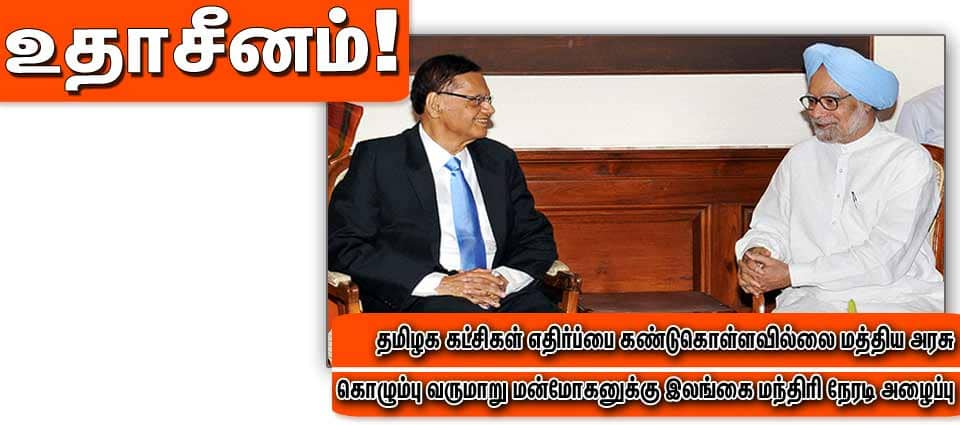
புதுதில்லி:"இலங்கையில் நடைபெறும்
காமன்வெல்த் நாடுகளின் மாநாட்டில்,
பிரதமர் மன்மோகன் சிங் பங்கேற்கக் கூடாது' என,
தமிழக அரசியல் கட்சிகள்
வலியுறுத்தி வரும் நிலையில்,
அதை உதாசீனம் செய்யும் வகையில்,
இலங்கை
வெளியுறவு அமைச்சர் பெரீசை,
பிரதமர் மன்மோகன் சிங்கும்,
வெளியுறவு அமைச்சர்
சல்மான் குர்ஷித்தும்,
நேற்று சந்தித்து பேசினர். அவரும், கொழும்பு வரும்படி,
பிரதமர் மன்மோகனுக்கு அழைப்பு விடுத்தார்.
இலங்கையில், 2009ல், விடுதலைப் புலிகளுக்கும், ராணுவத்திற்கும் இடையே நடந்த, கடைசி கட்டப் போரின் போது, ஏராளமான போர்க் குற்றங்களும், இனப் படுகொலைகளும் நிகழ்ந்தன. தமிழர்களுக்கு எதிராக நடந்த, இந்த பாதகங்களுக்கு நீதி கேட்டு, தொடர்ந்து, பல போராட்டங்கள் நடைபெற்று வருகின்றன.அதனால், "நவம்பர், 15 முதல், 17ம் தேதி வரை, இலங்கை தலைநகர் கொழும்பில் நடக்கும், காமன்வெல்த் நாடுகளின் தலைவர்கள் கூட்டத்தில், பிரதமர் மன்மோகன் சிங் பங்கேற்கக் கூடாது' என, அ.தி.மு.க., - தி.மு.க., என, தமிழக அரசியல் கட்சிகள் பலவும் வலியுறுத்தி வருகின்றன.இது தொடர்பாக, பிரதமருக்கு, முதல்வர் ஜெயலலிதா இரு முறை கடிதங்களையும் எழுதியுள்ளார். "பிரதமர் மன்மோகன் சிங், இலங்கைக்கு செல்லக்கூடாது' என, பார்லிமென்டிலும், தமிழக எம்.பி.,க்கள், குரல் எழுப்பி வருகின்றனர். நேற்றும் கூட, ராஜ்யசபாவில், இது தொடர்பாக, தமிழக எம்.பி.,க்கள் பேசினர்.
இந்தச் சூழலில், காமன்வெல்த் நாடுகளின், மாநாட்டில் பங்கேற்க வரும்படி, பிரதமர் மன்மோகன் சிங்கிற்கு, இலங்கை அதிபர் ராஜபக்ஷே சார்பில் அழைப்பு விடுக்க, அந்நாட்டு வெளியுறவு அமைச்சர் பெரீஸ், நேற்று முன்தினம் டில்லி வந்தார். நேற்று அவர், பிரதமர் மன்மோகன் சிங்கை சந்தித்துப் பேசினார்.
இந்தச் சந்திப்பு தொடர்பாக, மத்திய அரசு வட்டாரங்கள் கூறியதாவது:தமிழக மீனவர்கள், 100க்கும் மேற்பட்டோர், இலங்கை கடற்படையினரால், சிறை பிடிக்கப்பட்டு, அந்நாட்டு சிறைகளில் வாடி வருவது குறித்து, அமைச்சர் பெரீஸ் உடன் பேசிய, பிரதமர் மன்மோகன் சிங், மனிதாபிமான அடிப்படையில், அவர்களை விரைவில் விடுவிக்க வேண்டும் என, கேட்டுக் கொண்டார்.இலங்கையில் நடைபெறவுள்ள வடக்கு மாகாண கவுன்சில் தேர்தல்கள் குறித்து கேட்டறிந்த பிரதமர் மன்மோகன், இதன் மூலம், இலங்கை வாழ் மக்களிடையே, சமரச உணர்வு அதிகரிக்கும் என்று தெரிவித்தார். தேர்தலை, சுதந்திரமாகவும், நேர்மையாகவும், நம்பகமான முறையிலும் நடத்த வேண்டும் என்றும் வலியுறுத்தினார்.இதற்கு பதில் அளித்த, இலங்கை அமைச்சர் பெரீஸ், "வடக்கு மாகாண கவுன்சில் தேர்தலுக்கான பிரசாரம், தீவிரமாக நடைபெற்று வருகிறது. ஒன்பது அரசியல் கட்சிகளைச் சேர்ந்த, 350 பேர் போட்டியிடுகின்றனர்.
காமன்வெல்த் மற்றும் சார்க் நாடுகளைச்
சேர்ந்தவர்கள், தேர்தல்
பார்வையாளர்களாக அழைக்கப்பட்டுள்ளனர்'
என்றார்.காமன்வெல்த் மாநாட்டில் கலந்து கொள்ள வரும்படி, தனக்கு அழைப்பு விடுத்த,
இலங்கை அரசுக்கு,
பிரதமர் மன்மோகன் சிங் நன்றி தெரிவித்தார்.இவ்வாறு மத்தியஅரசு வட்டாரங்கள்
தெரிவித்தன.
பிரதமரைச் சந்தித்த பின், வெளியுறவு அமைச்சர் சல்மான் குர்ஷித்தையும், பெரீஸ் சந்தித்தார். அப்போது, இலங்கையில் சிறையில் அடைக்கப்பட்டுள்ள, தமிழக மீனவர்களை விடுதலை செய்வது, இந்திய - இலங்கை மீனவர்கள் சங்கத்தினர் சந்தித்து, தங்களுக்குள்ள பிரச்னைகள் குறித்து பேசுவது உட்பட, பல விஷயங்கள் குறித்து விவாதிக்கப்பட்டன.இலங்கையில், தமிழர்களுக்கு எதிராக நடந்த அத்துமீறல்களை கண்டிக்கும் வகையில், அந்நாட்டில் நடைபெறவுள்ள, காமன்வெல்த் நாடுகளின் மாநாட்டை, இந்தியா புறக்கணிக்க வேண்டும்; பிரதமர் மன்மோகன் சிங் பங்கேற்கக் கூடாது என, தமிழக அரசியல் கட்சிகள் வலியுறுத்தி வரும் நிலையில், அந்த எதிர்ப்பை கண்டுகொள்ளாமல், அதை உதாசீனம் செய்யும் வகையில், இலங்கை வெளியுறவு அமைச்சர் பெரீசை, பிரதமர் மன்மோகன் சிங் நேற்று சந்தித்து பேசியுள்ளார் என்பது குறிப்பிடத்தக்கது.
இலங்கை அமைச்சரின் பேச்சு அமைச்சர் வாசன் கண்டனம்:""தமிழக மீனவர்களை விடுவிப்பது குறித்து, இலங்கை வெளியுறவு அமைச்சர் பெரீஸ் கூறியுள்ள கருத்து கண்டனத்திற்குரியது,'' என, கப்பல் போக்குவரத்துத் துறை அமைச்சர் வாசன் தெரிவித்தார்.பிரதமர் மன்மோகன் சிங்கை சந்திக்க டில்லி வந்த பெரீஸ், நிருபர்களிடம் பேசும் போது, "கச்சத் தீவை திரும்ப தர முடியாது; அது, முடிந்து போன பிரச்னை. கடல் எல்லையைக் கடந்து வரும் தமிழக மீனவர்களை கைது செய்வது, சரியான நடவடிக்கை' என, கூறியிருந்தார்.
இது தொடர்பாக, மத்திய அமைச்சர் வாசன், சென்னையில் நேற்று கூறியதாவது:சிறை பிடிக்கப்பட்ட, தமிழக மீனவர்களை விடுவிக்க மாட்டோம் என, இலங்கை அரசு, பல தடங்கல்களை ஏற்படுத்துகிறது. இதை, அந்நாட்டு வெளியுறவு அமைச்சர் பெரீசும் வெளிப்படையாக தெரிவித்துள்ளார். இதுஏற்புடையதல்ல; கண்டிக்கத்தக்கது.இலங்கை அமைச்சரின் பேச்சு, தமிழக மக்களுக்கு, ஆத்திரத்தை ஏற்படுத்தியுள்ளது. இது போன்ற செயல்கள், மீனவர் பிரச்னையில், இரு நாட்டிற்கும் இடையே நடைபெறவுள்ள, சுமுக பேச்சு வார்த்தைக்கு இடையூறாக அமையும்.இவ்வாறு அமைச்சர் வாசன் கூறினார்.
மத்திய அமைச்சர் நாராயணசாமி அளித்த பேட்டி:இலங்கை தலைநகர் கொழும்பில் நடைபெறவுள்ள, காமன்வெல்த் நாடுகளின் மாநாட்டில் பங்கேற்க வரும்படி, பிரதமர் மன்மோகன் சிங்கிற்கு, அழைப்பு விடுக்க, இலங்கை அமைச்சர்கள் மற்றும் தலைவர்கள், டில்லி வந்துள்ளனர்; அது தவறல்ல."காமன்வெல்த் மாநாட்டில், இந்தியா பங்கேற்கக் கூடாது' என, முதல்வர் ஜெயலலிதா, தி.மு.க., தலைவர் கருணாநிதி ஆகியோர் பிரதமருக்கு கடிதம் எழுதியுள்ளனர்.
தமிழக காங்கிரஸ் தலைவர் ஞானதேசிகன், டில்லி சென்று நேரடியாக, இக்கருத்தை வலியுறுத்தியுள்ளார்.தமிழகத்தைச் சேர்ந்த பல்வேறு அரசியல் கட்சிகளும், இதே கருத்தை வலியுறுத்தி வருகின்றன. காமன்வெல்த் மாநாடு, நவம்பரில் நடைபெற உள்ளது. இதில், இந்தியா பங்கேற்பது குறித்து, வெளியுறவு அமைச்சர் சல்மான் குர்ஷித்திடம் கலந்து பேசி, பிரதமர் நல்ல முடிவை எடுப்பார்.இவ்வாறு நாராயணசாமி கூறினார்.
இதற்கு குழுசேர்:
இடுகைகள் (Atom)