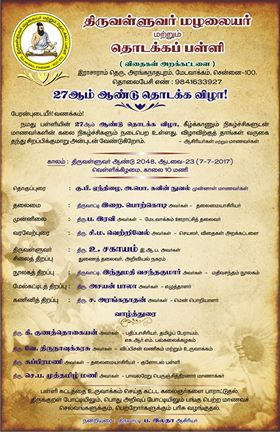
பள்ளியின் நூலகத் திறப்பு: திருவாட்டி இந்துமதி வசந்தகுமார்
மேல்கட்டடத் திறப்பு: எழுத்தாளர் அசயன் பாலா
கணிணிமையத் திறப்பு: திரு.ச.அரங்கநாதன்
சான்றோர்களின் வாழ்த்துரைகளும்,
மாணவர்களின் கலை நிகழ்ச்சிகளும் நடைபெற உள்ளன.
சிறப்புமிகு விழாவிற்குத் தாங்கள் வருகை தந்து சிறப்பிக்குமாறு
அன்புடன் வேண்டுகிறோம்.
Understanding ‘Quisling politics’ and facing it with ‘Navaratnam School of Thought’
[TamilNet, Tuesday, 04 July 2017, 23:31 GMT] The internal and external proponents of unitary constitution of
genocidal ‘Sri Lanka’ want to remove Justice C.V. Wigneswaran from the
position of Chief Minister in the NPC at whatever price before selling
the Singapore principle-based SL Constitution to Eezham Tamils. The
proponents want to preserve the unitary character of SL State. This
means preserving the genocidal character of the SL State as far as
Eezham Tamils are concerned. All the previous constitutions in the
island have been rejected by Tamils. Knowing the Tamil discourse of the
past very well, the external powers, particularly the West, is currently
promoting ‘Quisling politics’ among Tamils. It is therefore vital to
grasp the synthesis of the Quisling politics and regain the strength to
address it through the approach embraced by enlightened leaders of
Eezham Tamils in the past.
In an interview to TamilNet this week Premachandran explained how
ridiculously the unitary state system is going to be preserved through
the Sinhala term Ēkīya Rājyaya (ඒකීය රාජ්යය) while in English and Tamil
they will be using some other terms to sound as ‘united’.
However,
whenever a constitutional matter is subjected to legal interpretation,
as in the past, it would be the Sinhala version that would be used as
the source. SL Supreme Court will determine it as unitary overriding
everything else. Mr Sampanthan and Mr Sumanthiran know this very well.
But, they are going to tell something else to the Tamils to sell the SL
Constitution, Mr Premachandran said.
Sampanthan and Sumanthiran
are the only Tamil parliamentarians in the Steering Committee for
Constitutional Affairs on behalf of the TNA. Both of them are ITAK
politicians.
In
Sinhala, there is a different word for united in the context of union,
which is Eksat (United: එක්සත් / Eksat; Unitary: ඒකීය/ Ēkīya). The SL
Supreme Court could even determine the use of the term Eksat as unitary
in a legal context if there is no proper explanation attached to it.
The
advice to avoid the use of terms such as federal and unitary was coming
from none other than the ultimate culprits themselves.
The non-descript approach was finally adopted through the Singapore Principles of Quisling politics in 2013.
Last
year, a series of seminars organised by Jayampathy Wickramaratne's
Institute of Constitutional Studies with the support of Switzerland
Embassy and attended by a Co-Director of Switzerland-based Institute of
Federalism. Professor Eva Maria Belser from Switzerland was stressing
that “ terminology should not be a key issue” in the constitutional process.
The
target of the external players as well as the Colombo regime and the
ITAK incumbency is to counter the school of thought embraced by Thanthai
SJV Chelvanayakam, using the ITAK itself.
The immediate target
of the Quisling politics today is silencing Justice C.V. Wigneswaran
from restoring the school of thought within the TNA. That is why he is
being targeted.
The post-2009 discourse behind the hijack of TNA through ITAK:
Ilangkai
Thamizh Arasuk Kadchi (ITAK), popularly known by its English name
‘Federal Party’ for almost three decades since its formation in 1949,
was closed down as a party in 1976 by none other than its co-founder
Thanthai S.J.V Chelvanayakam as the projection of federal demand on
behalf of Tamils had become a foregone chapter in Tamil politics.
Since
then, the ‘exercise’ of engaging in proposing federal proposals that
could stand the evaluation test by Tamils, has been left for Sinhala
South or third parties. The focus on Tamil struggle has been to create
de-facto situations based on fundamental principles that could place the
Sinhala South to come up with an acceptable solution to the national
question.
V.
Anandasangaree of the TULF was blocking the use of ‘Rising Sun’ as the
symbol for the use of Tamil National Alliance (TNA) in 2004. All the
remaining politicians of the TULF, including R. Sampanthan, decided to
use the HOUSE symbol after consultations with the LTTE in 2004. The
party was not called ‘Federal Party’ anymore. It was called by its Tamil
name Thamizh Arasu (Tamil State) also in English, abbreviated as ITAK,
which was also the legal name on paper since its inception.
This is how the ITAK came into existence through the TNA.
The
LTTE was functioning as the final authority to be consulted in the
crucial matters including the fielding of candidates who were to
represent the alliance, be it ITAK, ACTC, TELO or EPRLF (Suresh).
There
was no technical formula on how decision-making should take place
within the TNA alliance as the final consensus on crucial matters was
carried out in consultation with the LTTE.
But after the
genocidal annihilation of the de-facto State of Tamils in 2009, the ITAK
using the HOUSE symbol as its trump card within the TNA was demanding
greater share in the decision making of the TNA.
Those who
confronted the hijacking sections of the ITAK hierarchy, particularly
the ACTC, found themselves at a situation to depart their ways with the
ITAK line of deceptive politics dominating the TNA.
Politicians
without ideological commitment, who got into parliamentary politics
using the seats offered by the EPRLF, such as S Shritharan from
Ki’linochchi, were quickly recruited by the ITAK to leave the EPRLF and
join the ranks of ITAK after being elected to the SL Parliament. Such
collaboration of opportunistic politicians also weakened the balance of
power within the TNA.
External players, particularly the
diplomatic missions in Colombo and certain Diaspora activists playing in
the hands of the external powers, steering the affairs also played a
role through M.A. Sumanthiran in sustaining the incumbency within the
TNA.
The ITAK, hijacked and controlled by a few after 2009 and
systematically groomed by the external agenda-setters, has emerged as
the Quisling outfit to engage in collaborationist politics with the
occupying genocidal State and with the external agenda setters.
The
ultimate motive was to counter the righteous struggle-centric Tamil
politics by controlling the election manifesto of the TNA and sustaining
the Quisling make-up through a groomed incumbency within the ITAK. Even
the senior politicians of the ITAK were effectively side-lined by
Sumanthiran incumbency. The octogenarian TNA parliamentary group leader
of the TNA, R. Sampanthan, is serving the Quisling politics of
Sumanthiran from a comfortable position of Opposition Leader in the SL
Parliament.
ITAK is only a tool for retaining the
decision-making of the TNA favourable to the external agenda setters and
their engagement with the agent-State in Colombo.
Politicians
like Suresh Premachandran who gravely failed to address the deviation of
the ITAK hijackers already in the beginning when the ACTC was
challenging the phenomena have now realised their failure and have come
forward to at least convey the message openly to the public.
* * *
The School of Thought embraced by SJV Chelvanayakam
With
the 1976 formation of Tamil United Liberation Front (TULF) and the
abandonment of federal demand as political aspiration of Eezham Tamils,
Mr Chelvanayakam on his last leg of politics (1972 - 1976) evolved a new
chapter, embracing the Tamil Sovereignty School of Thought or better described as Navaratnam School of Thought in the post-2009 context.
As V. Navaratnam theoreticized it in 1969 and as Chelvanayakam embraced it during the scuttling of the ITAK, forming of the TULF and the establishment of the landmark Vaddukkoaddai Resolution
7 years after parting ways with Navaratnam, the Tamil struggle was
supposed to be waged from the platform uncompromising the basic
principles of Tamils right to full self-determination
and the distinct sovereignty of the nation of Eezham Tamils to the
traditional homeland in the North-East of the island (North-East doesn't
imply the current provincial borders as defined by the SL State) from
1976 onwards.
Due to Sinhala leadership's chequered history, which was full of
unilateral nullification of pacts and outright reversals of agreements
with the Tamil leadership and due to the continued legacy of cultural
genocide that was being experienced by Tamils, it was now “sine qua non”
for the Tamils to articulate their political aspiration without
limiting the scope of their right to self-determination to ‘internal’
(federal) dimension alone. The ‘external’ right to self-determination
and distinct sovereignty to Tamil nation's homeland could not be
subjected to compromise. (In fact, Right to Self-Determination as a
right cannot be universal and inalienable if it was to be limited to be
‘internal’ as such).
As far as the aspirations and demands of
Tamils are concerned, the territorial integrity of their homeland could
no longer be conceptually subjugated to the notion of territorial
integrity of the SL State that had no Tamil mandate during its State formation (constitutions of 1948, 1972 and 1985 were democratically denounced by the Tamils) or was violating the democratic Tamil mandate of 1977.
1977
General Elections was the last ever public elections in the island in
which Tamils had the democratic franchise to articulate and vote for
their political aspiration. The SL State has forbidden articulation of
external right to self-determination and distinct sovereignty through
the 6th Amendment to its Constitution in 1983.
The Tamil politics should now be based on regaining the lost sovereignty of Tamils based on both historical and remedial
claims and therefore Tamils cannot subscribe to the federal demand
anymore as it violated the sine qua non requirement of the school of
thought being embraced by S.J.V Chelvanayakam.
* * *
Chelvanayakam’s how-to on future Tamil position on federal proposals:
S.J.V
Chelvanayakam was eloquent enough in articulating the ‘how-to’ of this
play rule for when and how Eezham Tamils could accommodate towards a
federal solution without compromising their political discourse.
Eezham
Tamils as a nation could only be prepared to consider a federalist
proposal in a situation when the Sinhala South (or an international
third party) was prepared to offer it as a last resort. But, the Tamil
polity should never engage in the exercise or experiment or joint
exercises of drafting a federal proposal.
The Tamil approach
should be focused instead on waging the struggle and creating de-facto
situations for the Sinhala South to come with an acceptable proposal for
a federal solution as its last resort to escape separation or isolation
from global humanity.
It is vital for anyone claiming to
represent Tamil aspirations and the legacy of S.J.V Chelvanayakam to
grasp exactly how Thanthai Chelva in fact had conceived the future
political platform of Eezham Tamils.
Any Tamil party claiming to
represent what SJV Chelvanayakam, who through his long experience
embraced and evolved, should realise that they cannot engage in
proposals below a true confederal arrangement.
The Tamil polity
should be firm in stressing the underlying principles and not engage in
proposing anything less than a confederal.
Otherwise, it is the
Sinhala South and its global sponsors who should bear the responsibility
of presenting any lesser formulas falling within the federal
arrangement. Tamils should be prepared to denounce if such proposals
don’t meet their expectations of resolving their national question.
* * *
Quisling Politics: straight from the horse’s mouth:
Currently,
R. Sampanthan and M.A. Sumanthiran are engaged in violating this. That
is why they are being perceived as proponents of Quisling politics.
How
‘elegantly’ the duo is engaged in Quisling politics in violation of
S.J.V. Chelvanayakam's roadmap is better explained by none other than
M.A. Sumanthiran himself in his 11 February 2017 address at the Bar
Association in Jaffna.
The hijack has been possible because the
ITAK, except Mr Sampanthan and Mr Sumanthiran, consists of dumbest Tamil
parliamentarians of all times in the history of the ITAK and the TULF.
Three
key aspects of Quisling politics so far have been 1) advocating
collaboration politics with genocidal State, 2) genocide denial and 3)
scuttling of international investigations.
In fact, all the
speeches and statements that have come from Sumanthiran from the times
of the so-called Oslo Declaration should serve as valuable documents
from the perspective of a devil’s advocate in shaping the future
discourse of Navaratnam Pirapaharan School of Thought.
The
most effective way of addressing the Quisling politics being advocated
by Sumanthiran, is redefining the Tamil National Alliance (TNA) itself.
So
far, the paradigm of Quisling politics openly advocated by Mr
Sumanthiran has not been effectively countered by those claiming to be
the adherents of Tamil nationhood and sovereignty-centred political
discourse, be it political party leaders challenging the ITAK, civil
society experts who often miss their target, the fellow party leaders
within the TNA confronting the ITAK, political analysts or television
talk-show hosts serving the corporate operated media outlets.
Sumanthiran often scoffs at his political opponents and walks free of ideological challenge.
The
usual argument coming from him is that “you are telling exactly what I
have been saying all these years”. His opponents, despite their hard
work, have failed to present a paradigm capable of constituting a school
of thought that is compatible with the evolution of Tamil struggle.
The major impediment is electoral politics in the island.
The
political struggle has to be taken forward by a movement that doesn't
subject itself to the restrictions of ‘territorial integrity’ or ‘sixth
amendment’ or any of the aspiration- and freedom- restricting parameters
of the SL Constitution.
Therefore, those who take oaths could
only act as proxies or transition-setters while leaving the mainstream
struggle to the peoples’ movement.
Until a real mainstream
movement is established, there will be situations of experiments and
transitions in addressing the Quisling politics of the ITAK. The Tamil
National People’s Front (TNPF), Tamil People’s Council (TPC) and the
gravity towards Justice C.V. Wigneswaran, all fall into this category.
What
is most important for the transitional experiments such as the TPC is
not to succumb as a spoiler itself violating the mainstream school of
thought as it did with the draft proposals for a ‘federal’ constitution.
Any
creation of transition or alternative should have the larger vision of
safeguarding and course-correcting the TNA and not accelerating the
centrifugal destruction of the body.
The thought of destroying
and annihilating TNA is self-destructive and suicidal for the nation of
the Eezham Tamils, especially in the political vacuum of a sole
representative.
After Sampanthan, TNA will be at the risk of
losing its centripetal force. Therefore, those engaged in the
course-correction of the TNA should act with a vision of inclusive and
unifying moral high ground with steadfast commitment and clarity on the
fundamental principles as the leaders of foregone paradigms have
demonstrated both in their words and deeds.
Without an in-depth
understanding and commitment to the school of thought embraced by the
Tamil national leaders, it would not be possible to address the
course-correction.
As the coordinator of May 17 Movement,
currently jailed in Tamil Nadu after organising a peaceful vigil
remembrance for those who perished in Mu’l’livaaykkaal put it in an
interview with TamilNet in March 2017, it is important that Tamils world
over realise the danger of the rope surrounding their necks in the form
of the constitutional discourse. The interview with Thirumurugan and
Diaspora activist Lathan Suntharaligam addressing Quisling politics is
being published with this article for the perusal of Eezham Tamils in
the homeland and in the diaspora.
Certain civil society activists on the ground who showed a keen interest in countering 13th Amendment have totally failed to expose the US bandwagon which is playing the most destructive game against Eezham Tamils through the Quisling politics.
Tamil
activists ending up as serving the agenda of powers and crisis managers
should be identified and course-corrected by the grassroots of the
nation of Eezham Tamils. And finally, those asking about lacking
roadmap, also need to realize that a lot has also been already
consolidated as blueprints and roadmaps.
The SL military on Monday released 27 acres along the fishing jetty
in Mayiliddi in Valikaamam North and another lot of 27 acres surrounding
a Hindu temple near the locality. Amidst the big propaganda, no
residential lands were released. All those who wanted to witness the
‘release’ of lands were taken by the occupying SL Army in military
vehicles across the ‘High Security Zone’ and later brought back in the
same vehicles. There is no land link for the people to access the
released pocket of lands.
Anyone who wants to access the temple and the jetty have to travel by boat from Kaangkeasanthu’rai or from Point Pedro.
What
is the point in releasing the pocket without a land link asked the
people who witnessed the ‘release’ of lands. It is only an eyewash,
said the fishermen who were present.
“It is only an eyewash. The
military has put up new fences. Their intention is very clear. It is
not going to be easy to get the lands released,” an uprooted fisherman
from Mayiliddi who visited the pocket told TamilNet.
“There are
more than 6,000 acres of lands that need to be released. How many years
it is going to take if lands get released in this speed,” he asked.
Tamil blood-infuse campaign draws Sinhala-Buddhist monks in genocidal Sri Lanka
[TamilNet, Sunday, 02 July 2017, 09:49 GMT] A false propaganda was recently let loose through Sinhala media in
the South hinting that Tamils in the North were reluctant to donate
their blood to the blood bank in Jaffna due to ‘caste differences’
prevailing among them. The propaganda, seems to have originated from
Colombo’s “Army and Archaeology,” which is interlinked with the
extremist sections of Buddhist Establishment. After the Goebbelsian
tactic of connecting ‘caste’ and ‘Tamil blood’, a section of extremist
Sinhala monks were brought to Jaffna with symptoms of ‘superiority
complex’ to donate ‘Sinhala blood’ to the blood bank in Jaffna,
commented medical sources in Jaffna. The same tendency was working in
the rape of Tamil women too, said Tamil political observers.
Without realizing that
there is nothing ethnic or casteist in the medical affair of blood
banking, the joint extremism of Sinhala Army, Archaeology and Theravada
Buddhism was creating new myths of triumphalism ridiculing the Eezham
Tamils, doctors at the Jaffna hospital said.
The exercise by
monks was not much different from what Tamils are accustomed from time
to time from Orientalist academia of West prompting younger generation
Eezham Tamil academics to engage in casteism research, commented
political observers in Jaffna.
Physicians attached to Jaffna
Hospital said there has been no acute shortage of blood nor there were
any casteist phenomenon connected to blood banking.
“Initially, we got a request for
appointment from a military commander. We thought soldiers were going to
be sent for blood dontation as they do during the times of Vesak. But,
it was an army of monks who showed up. A number of them were child
recruits. As usual, we were looking at their age, weight, blood-pressure
and other medical aspects. Unfortunately, a large number of the younger
generation monks didn’t qualify as blood donors. But, we were not aware
of the campaign in the Sinhala press before the monks themselves came
with certain comments after donating the blood,” a physician attached to
Jaffna hospital said.
Even though 76 Monks came to donate their
blood to the blood bank, only 16 of them were eligible for blood
donations, the physician further said.
NPC Governor Reginald
Cooray was also operating with the SL military commanders in
facilitating the ‘blood donation’ propaganda, news sources in Jaffna
said.
UN in Myanmar reaps what it has sown in genocidal Sri Lanka
[TamilNet, Saturday, 01 July 2017, 14:47 GMT] Myanmar on Friday surpassed ‘Sri Lanka’ in challenging UN scrutiny of
its crimes against humanity and ethnic cleansing. Myanmar will refuse
entry to members of a UN probe focusing on allegations of killings, rape
and torture by its security forces against Rohingya Muslims. In
addition, it wants to keep the so-called ‘Domestic Investigation’ in the
hands of people coming from the very military against which the
allegations are made. As Myanmar follows genocidal Sri Lanka, UN is
heading for the fate of The League of Nations. Defying international
norms on people’s affairs such as human rights has to be carefully
differentiated from defiance shown to the UN on other matters, as the
former is the worst one from the vantage of the masses, and elements
that advise and back such State defiance are the worst enemies of
humanity, commented Tamil activists for alternative politics in the
island.
A UN report this year said that mass killings and gang rapes of Rohingya
amounted to crimes against humanity and possible ethnic cleansing.
In
March, EU brought a resolution in Geneva calling for a mission to look
into the allegations as well as abuses in other longstanding ethnic
conflicts in the country.
As in the case with genocidal Sri
Lanka, New Delhi and Beijing competing with the West to have entry into
the country, jumped to save the Establishment in Myanmar. The most
articulating was New Delhi.
The UN missions and nominees could
hardly go beyond playing handmaids to global agenda-setters. For
instance, Angelina Jolie didn’t see genocide-motivated Sinhala military
rape in the island. But, whenever a probe on human rights is
structurally denied for whatever the reason of geopolitics, it morally
affects the victims worse than the atrocities committed on them. The
anger will only turn against those who engineer the denial.
Reuter
on Friday cited Aung San Suu Kyi saying in Sweden this month that the
UN mission "would have created greater hostility between the different
communities". The majority in Rakhine are ethnic Rakhine Buddhists who,
like many in Buddhist-majority Myanmar, see the Rohingya as illegal
immigrants from Bangladesh.
This is in line with the excuse
coming from many Sinhala-Buddhist establishments, even when Eezham
Tamils are a parallel historical nation in the island.
A group of
Myanmar Buddhist monks recently coming to Jaffna in the company of
Sinhala Buddhist monks was seen as giving moral support to the on-going
genocidal colonization in the occupied country of Eezham Tamils.
Over
concerned about Islam, opinion is obtuse to what other religious
institutions, especially Theravada Buddhism and Hindutva do in the
region at present.
The State in Colombo, having long experience
in deceiving the nation of Eezham Tamils, has successfully extended the
expertise to deceive the world. The expertise is now exported to other
parts of the world.
The ‘Sri Lankan’ modus operandi of the
world’s first genocide in 21st century has institutionalized genocide
and camouflaged follow-up as accepted paradigms of world polity.
In
the case of Rohingya in Myanmar, lessons particularly go to Bangladesh,
Pakistan, Maldives and Bengalis in India in the region, whose
governments were a party to the ‘Sri Lanka’ paradigm; to a host of world
Muslim countries that were in the bandwagon; and to the countries in
Latin America that were carried away by the red shawl and deceptive
diplomats of Rajapaksa.
As States, powers and international
organizations are not likely to change, world may have to think of
alternative movements and methods to check culprits and empower victims,
especially in the area of collective human rights of peoples and
nations.
Nullified ownership of lands not revoked by Colombo: resettled Champoor Tamils
[TamilNet, Friday, 30 June 2017, 23:40 GMT] Occupying Colombo has once again proved its systematic violation of
traditional land ownership rights of Eezham Tamils to their private
lands in Champoor, complain representatives of Vinaayakar Community
Centre (Chana-chamooka-nilaiyam) from Champoor in Moothoor East of
Trincomalee district. The families in Champoor had residential and
agricultural lands as combined tracts of lands that measured from 0.5
acre to 2 acres per family before they were uprooted from their village
in September 2006. Now, the occupying Colombo wants to limit their
ownership rights to just 20 perches per family, the representatives of
Vinaayakar Community Centre told TamilNet on Friday.
The SL State appropriated the private lands of Eezham Tamils in Champoor
after uprooting the Tamils from Moothoor East by waging a genocidal
military onslaught on them in September 2006.
Later, in 2012,
the SL ‘State acquired’ lands were handed over to SL Board of Investment
by the then SL President Mahinda Rajapaksa through a Gazette
notification.
In 2015, the incumbent SL
President Maithiripala Sirisena allowed the people to resettle in
Champoor by promising to release 818 acres of lands. He revoked the 2015
Gazette notification of transfer of lands to BOI. But, the initial
seizure of lands, which was carried out according to a previous order
under the clause of the proviso to S.38A of the constitution of the
unitary State in Colombo, has not been properly revoked.
Instead
of restoring the original ownership of lands, occupying Colombo is now
trying to re-define the ownership based on its current laws for new
alienation of State lands to private parties.
Under these
provisions, a family could only expect 20 perches of lands, Colombo's
officials have informed the families. These lands are now seen only as
residential lands, they were told.
The people of Champoor have
vowed to launch a continues protest if Colombo fails to legally restore
their original rights to lands.
in the meantime, the occupying
Colombo wants to set up a solar power plant at Champoor in the lands it
had previously seized for the purpose of setting up a coal power plant
involving India.
A lot of agricultural lands belonging to Tamils
were illegally seized for the purpose of power plant. As the coal power
plant project has been abandoned, the people were expecting also their
lands to be released to continue their livelihood of agriculture and
farming. Now, the hopes of resuming their livelihood are again dashed,
civil activists in Trincomalee said.