திங்கள், 18 மே, 2015
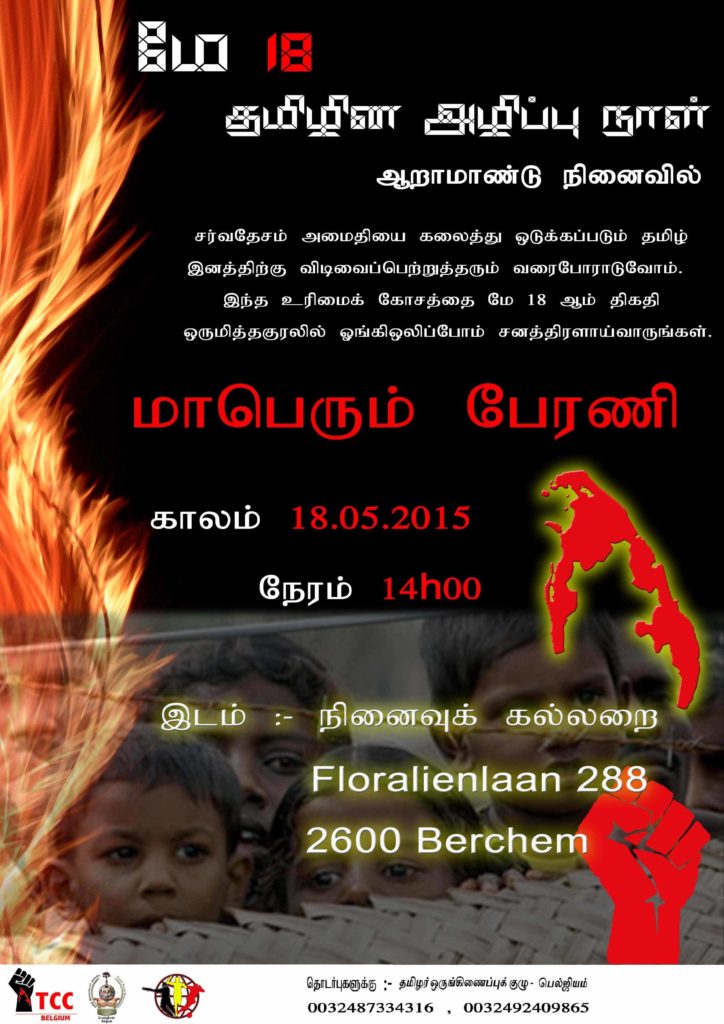


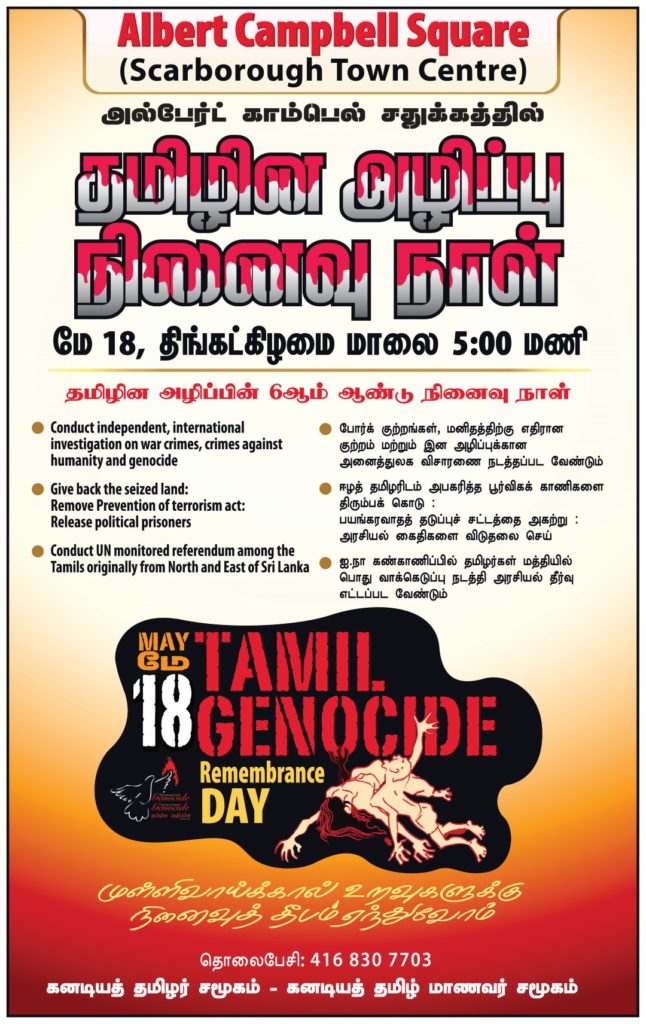
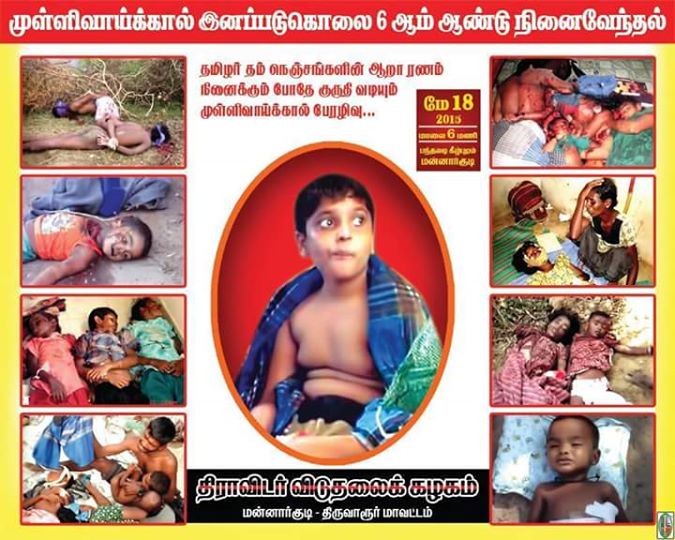
Multi-religious prayer organised at Mu'l'livaaykkaal on 18 May
Multi-religious prayer organised at Mu'l'livaaykkaal on 18 May
[TamilNet, Sunday, 17 May 2015, 15:16 GMT]
A group of Catholic priests have organised a multi-religious prayer service in commemoration of Mu'l'livaaykkaal massacre at St. Paul's Church in Mu'l'livaaykkaal on 18 May 2015 at 4:00 p.m., a priest from Mullaiththeevu told TamilNet Sunday. The religious prayer comes amidst tightened deployment of civil clad intelligence operatives monitoring each and every corner of Mu'l'livaaykkaal on Sunday.
The organisers have urged the people to come and join them in their memorial gathering.
The invitation said: The horror that history has taught of Mullivakal should never be repeated anywhere on this earth. Through this act of remembering, maybe no generation of people will suffer nor commit such atrocities against humanity again. This needs to be done by all of us every year and with every generation.
Chronology:
A group of Catholic priests have organised a multi-religious prayer service in commemoration of Mu'l'livaaykkaal massacre at St. Paul's Church in Mu'l'livaaykkaal on 18 May 2015 at 4:00 p.m., a priest from Mullaiththeevu told TamilNet Sunday. The religious prayer comes amidst tightened deployment of civil clad intelligence operatives monitoring each and every corner of Mu'l'livaaykkaal on Sunday.
The organisers have urged the people to come and join them in their memorial gathering.
The invitation said: The horror that history has taught of Mullivakal should never be repeated anywhere on this earth. Through this act of remembering, maybe no generation of people will suffer nor commit such atrocities against humanity again. This needs to be done by all of us every year and with every generation.
Chronology:
New mantra of ‘hybrid courts’ in the game of geo-politics
New mantra of ‘hybrid courts’ in the game of geo-politics
[TamilNet, Sunday, 17 May 2015, 10:57 GMT]
The US-based Human Rights Watch (HRW) was condemning the new regime of Sri Lanka for appointing Major General Jagath Dias, the war-time commander of the abusive 57 division of the SL Military as the new Army Chief of Staff. At the same time, the HRW was urging the new regime in Colombo to “put into place an effective accountability mechanism with a significant international component.” The Tamil people should note the terminology being adopted in the global orchestration in narrowing down the ‘pressure’ on Sri Lanka into a domestic process, Tamil activists for alternative politics in Jaffna cautioned on Sunday. Tamils should pay particular attention to how the HRW and other rights outfits are trying to justify a ‘domestic‘ process while the USA and China are competing with each other in building strategic partnerships in the Indian Ocean Region, the activists further said.
“The government should put into place an effective accountability mechanism with a significant international component,” the HRW said in its statement issued on Sunday.
The statement went on to say: “Previous government accountability mechanisms have been impaired by harassment, threats, and violence against witnesses and commissioners. The best way to address this problem would be to create a combined international and domestic court similar to the successful hybrid courts in Sierra Leone and Bosnia-Herzegovina.”
* * *
Responding, the Tamil activists for alternative politics said: “Within one year, the terminology being adopted by the personalities and outfits serving the global human rights regime has been systematically downplayed from ‘international mechanism’, through ‘international involvement’, and later ‘international assistance’ and into international component in Sri Lankan domestic investigations in addressing the war crimes and the crimes against humanity. The international players were systematically avoiding the term genocide.
What we have witnessed today in the statement issued by the US-based rights watchdog, is the introduction of the term ‘international component’ and the example of ‘hybrid courts’ of Sierra Leone and Bosnia-Herzegovina.
The global outfits serving the geopolitics are also directing the Colombo-based legal activists and NGO circles in Colombo in an effort to justify a domestic process, the activists said.
“This is an orchestration of geo-politics-driven human rights agenda and Tamils should take particular note of these developments, as they mark the Genocide Memorial Day on 18 May,” the Tamil activists said.
The Sri Lankan state, and all its organs including the judiciary, is a guilty party in the crime of genocide. The apprehension around hybrid courts is that it gives legitimacy to the guilty party by virtue of giving legitimacy to the local judiciary.
“The emerging students of international law among the global Tamils should subject the role played by the outfits such as the Human Rights Watch and the International Crisis Group to critical scrutiny,” the activists for alternative politics further said.
* * *
Former Puisne Judge of the Supreme Court of Canada, Louise Arbour, who became the UN Human Rights chief (1999 - 2004) and later the president and the CEO of the International Crisis Group (2009 - 2014), was reasoning out why the ICG was not supporting the claim of Tamil independence in the island. The ICG, under her leadership was in the forefront in denying the genocide committed on Eezham Tamils. Her successor in the UN Human Rights Commission, Navi Pillay, was also not recognising the allegation of genocide in 2013.
In an address to Carnegie Council for Ethics in International Affairs, Ms Arbour was also ‘explaining’ why the ICG was not backing the claim of ‘earned sovereignty’ to Eezham Tamils.
The video evidence added herewith would show how the CEO of the ICG, Louise Arbour. was negating the sovereignty and the demand for independence of Eezham Tamils in September 2010.+
ICG, at that time, was calling for ‘international investigation’ into the alleged war crimes in Sri Lanka. But, the group was promoting the paradigm of equating the violations of the oppressive and genocidal state of Sri Lanka with that of the LTTE and the orchestration at that time was that an international investigation should subject the war crimes of ‘both sides’.
Related Articles:
02.10.13 Question raised on truth of Navi Pillay statement
11.05.13 Genocide could be mandated by democracy of West: Malathy
09.10.12 Genocide needs investigation but separation contextually unw..
08.10.12 Academics question ICE deceit after Solheim's speech at Lond..
06.10.12 Solheim’s politics, UN role in SL criticized at Frances Harr..
11.02.12 War crimes of ‘both sides’ or war crimes of all sides: Oslo ..
30.09.11 Politics of Human Rights
The US-based Human Rights Watch (HRW) was condemning the new regime of Sri Lanka for appointing Major General Jagath Dias, the war-time commander of the abusive 57 division of the SL Military as the new Army Chief of Staff. At the same time, the HRW was urging the new regime in Colombo to “put into place an effective accountability mechanism with a significant international component.” The Tamil people should note the terminology being adopted in the global orchestration in narrowing down the ‘pressure’ on Sri Lanka into a domestic process, Tamil activists for alternative politics in Jaffna cautioned on Sunday. Tamils should pay particular attention to how the HRW and other rights outfits are trying to justify a ‘domestic‘ process while the USA and China are competing with each other in building strategic partnerships in the Indian Ocean Region, the activists further said.
“The government should put into place an effective accountability mechanism with a significant international component,” the HRW said in its statement issued on Sunday.
The statement went on to say: “Previous government accountability mechanisms have been impaired by harassment, threats, and violence against witnesses and commissioners. The best way to address this problem would be to create a combined international and domestic court similar to the successful hybrid courts in Sierra Leone and Bosnia-Herzegovina.”
* * *
Responding, the Tamil activists for alternative politics said: “Within one year, the terminology being adopted by the personalities and outfits serving the global human rights regime has been systematically downplayed from ‘international mechanism’, through ‘international involvement’, and later ‘international assistance’ and into international component in Sri Lankan domestic investigations in addressing the war crimes and the crimes against humanity. The international players were systematically avoiding the term genocide.
What we have witnessed today in the statement issued by the US-based rights watchdog, is the introduction of the term ‘international component’ and the example of ‘hybrid courts’ of Sierra Leone and Bosnia-Herzegovina.
The global outfits serving the geopolitics are also directing the Colombo-based legal activists and NGO circles in Colombo in an effort to justify a domestic process, the activists said.
“This is an orchestration of geo-politics-driven human rights agenda and Tamils should take particular note of these developments, as they mark the Genocide Memorial Day on 18 May,” the Tamil activists said.
The Sri Lankan state, and all its organs including the judiciary, is a guilty party in the crime of genocide. The apprehension around hybrid courts is that it gives legitimacy to the guilty party by virtue of giving legitimacy to the local judiciary.
“The emerging students of international law among the global Tamils should subject the role played by the outfits such as the Human Rights Watch and the International Crisis Group to critical scrutiny,” the activists for alternative politics further said.
* * *
Former Puisne Judge of the Supreme Court of Canada, Louise Arbour, who became the UN Human Rights chief (1999 - 2004) and later the president and the CEO of the International Crisis Group (2009 - 2014), was reasoning out why the ICG was not supporting the claim of Tamil independence in the island. The ICG, under her leadership was in the forefront in denying the genocide committed on Eezham Tamils. Her successor in the UN Human Rights Commission, Navi Pillay, was also not recognising the allegation of genocide in 2013.
In an address to Carnegie Council for Ethics in International Affairs, Ms Arbour was also ‘explaining’ why the ICG was not backing the claim of ‘earned sovereignty’ to Eezham Tamils.
The video evidence added herewith would show how the CEO of the ICG, Louise Arbour. was negating the sovereignty and the demand for independence of Eezham Tamils in September 2010.+
ICG, at that time, was calling for ‘international investigation’ into the alleged war crimes in Sri Lanka. But, the group was promoting the paradigm of equating the violations of the oppressive and genocidal state of Sri Lanka with that of the LTTE and the orchestration at that time was that an international investigation should subject the war crimes of ‘both sides’.
Related Articles:
02.10.13 Question raised on truth of Navi Pillay statement
11.05.13 Genocide could be mandated by democracy of West: Malathy
09.10.12 Genocide needs investigation but separation contextually unw..
08.10.12 Academics question ICE deceit after Solheim's speech at Lond..
06.10.12 Solheim’s politics, UN role in SL criticized at Frances Harr..
11.02.12 War crimes of ‘both sides’ or war crimes of all sides: Oslo ..
30.09.11 Politics of Human Rights
ஞாயிறு, 17 மே, 2015
Sri Lanka bans Remembrance events at Mu'l'livaaykkaal
Sri Lanka bans Remembrance events at Mu'l'livaaykkaal
[TamilNet, Saturday, 16 May 2015, 17:03 GMT]
The occupying State of Sri Lanka has banned the Northern Provincial
Council (NPC) members in Mullaiththeevu from taking part at the memorial
events to be held at Mu'l'livaaykkaal with the participation of the
public, according to an order issued by the SL courts in Mullaiththeevu
following a police complain, Deputy Speaker of NPC Antony Jeganathan
told TamilNet Saturday. The latest move is a gross violation hurting the
sentiments of Eezham Tamils, Mr Jeganathan said. A similar order has
been issued to the Tamil National Peoples Front (TNPF), the news sources
in Jaffna said. The Chief Minister of NPC, C.V. Wigneswaran had
officially invited all the parliamentarians and councillors from the
Northern Province to attend the memorial event at the Government Mixed
School at Mu'l'livaaykkaal East at 10:00 a.m. on 18 May.
The Chief Minister, Justice C.V. Wigneswaran, who is fully aware of the
Sri Lankan laws, made the decision to mark the memorial event for
civilians killed in the war without any procession at Mu'l'livaaykkaal,
the deputy speaker further told TamilNet.
The so-called interim ban was issued Saturday night as the SL Police got the Magistrate of Mullaiththeevu Magistrate's Court to issue the ban from his residence while the NPC or the TNPF cannot appeal against the decision before Monday on the day of memorial event.
However, Mr Jeganathan said the NPC councillors were determined to mark the memorial day as scheduled at Mu'l'livaaykkaal on 18 May.
The so-called interim ban was issued Saturday night as the SL Police got the Magistrate of Mullaiththeevu Magistrate's Court to issue the ban from his residence while the NPC or the TNPF cannot appeal against the decision before Monday on the day of memorial event.
However, Mr Jeganathan said the NPC councillors were determined to mark the memorial day as scheduled at Mu'l'livaaykkaal on 18 May.

C.V.
Wigneswaran's invitation to parliamentarians and provincial councillors
of the Northern Province to take part in the memorial event on 18 May

The court order given to TNPF by the SL Police
Chronology:
Politics of memorialisation discussed in Jaffna
Politics of memorialisation discussed in Jaffna
[TamilNet, Friday, 15 May 2015, 23:44 GMT]A Colombo-based Human Rights defender and an NGO researcher promoting ‘Sri Lanka’ reforms were proposing ‘space’ for ‘multiple narratives’ in the memorialisation process for an ‘inclusive’ Sinhala-Muslim-Tamil ‘Sri Lanka’ at a meeting held in Jaffna last Sunday. The activists from the South were advocating the right of memorialisation as part of a reparations of a reconciliation process as if the underlying genocidal conflict in the island had been resolved. The Tamil activists of the TCSF, defending the right of Eezham Tamils to mark their memorialisation as a collective right were also advocating a transformation within the Tamil nation, in order to accommodate space for various narratives within the mainstream Tamil nationalist discourse itself.
Such a process within the Tamil nation should be owned by the Eezham Tamils themselves strengthening their collective memorialisation of what should be remembered and passed on to the generations to come, the TCSF activists said.
காணுரை http://www.tamilnet.com/art.html?catid=79&artid=37771
Colombo-based Human Rights Defender, Ruki Fernando, who addressed the audience first, was giving examples of memorial events that he had witnessed in the past, obstructions of memorial events that were ‘non-tolerable’ by various actors and his observations on dark (black/grief) tourism. Mr Fernando raised the question of whether the people were remembering heroes or villains or whether there were blurred lines between these two. He concluded his address with the question of how to commemorate victims from different ethnic, religious groups, by different perpetrators. “Should we commemorate those who were engaged in abuses and violence, and if so, how should we do it,” Ruki Fernando asked adding that, for him, the lines were blurred on the question of discussing victims and perpetrators.
Attorney-at-Law Bhavani Fonseka, who is a senior researcher at Colombo-based Centre for Policy Alternatives, was talking about how to move forward without becoming a hostage to the past. What happened in the past is a critical element in terms of reconciliation, she said. But, it is important not to be bogged down in the past that you forget that there are things that can happen in the future, she said.
Ms Fonseka was reiterating that there should be space for different narratives and that there should be a balance between the past and the future.
Bhavani Fonseka was particular about the ‘danger’ of a ‘single story’ narrative as outlined by the Nigerian author Chimamamanda Ngozi. The SL State was going there in the last 10 years, she said.
She was referring to the ‘new initiatives’ by former president Chandrika Kumaratunga such as the ‘effort’ of creating a Common Wall with the names of those perished regardless of their ‘ethnic’ background. Ms Fonseka was talking about the many pages of the LLRC, presidential commissions and looking at memorialisation as part of a larger reconciliation project.
Rev Fr Eili Rajan, a co-spokesperson of the TCSF, who identified the post-genocide period as the period for transitional justice. But, the so-called development activities of the current regime could not be categorised as part of the reparations, which are related to human rights, he said. The current regime is only applying a basic needs oriented development strategy as a ‘development tactics’ to deceive the Tamil people away from proper reparations, he said.
Fr Elil Rajan was touching on the role of the historiography in concealing the genocides, particularly how Western notions of historiography failed in addressing the past of the non-Western World. Elil Rajan, who is a visiting lecturer on Political Science at the Eastern University was stressing on alternative methods of documenting genocides and the need for media in addressing ‘the others’ who were ignored by the historians.
Discussing how the ‘war on terror’ paradigm brough by former US President George Bush was abetting the genocide against the Eezham Tamils in the island, Fr Elil Rajan referred to the notion of ‘counter counter-insurgency’ as described by assassinated Tamil journalist Sivaram Dharmeratnam.
Attorney-at-Law Guruparan Kumaravadivel, the other co-spokesperson of the TCSF said the modern Nation-states were able to foster their identity as political communities through their collective memorialisation. He was citing the American civil war in the shaping of the United States of America, the World War memories in shaping the German identity and the French revolution in the identity of France.
It is a false dichotomy to differentiate between private and public memorial events, Guruparan said.
The SL State, regardless of the regimes coming to power, has been opposed to memorialisation by Tamils as it wants to politically suppress the Tamils from being reminded upon their right to self-determination. That is why the SL State tolerates to some extent the individual and private memorialisation while being strictly opposed to Tamils' collective right to their memory, he said.
Guruparan described the differentiation between the collective memory as a collection of individual and private memorial events and as a collective event of a politicised community, was a divide-and-rule tactic of liberalism. Described it as a jigsaw puzzle, the lecturer in law at the University of Jaffna said it was possible to have achieve the needed inclusiveness and space for different narratives within the collective memorialisation of a politicised community
காணுரைகள் 4
http://www.tamilnet.com/art.html?catid=79&artid=37771
http://www.tamilnet.com/art.html?catid=79&artid=37771.
http://www.tamilnet.com/art.html?catid=79&artid=37771
1http://www.tamilnet.com/art.html?catid=79&artid=37771
Related Articles:
25.11.09 Heroes and rulers, eternal struggle of humanity
Chronology:
இதற்கு குழுசேர்:
இடுகைகள் (Atom)